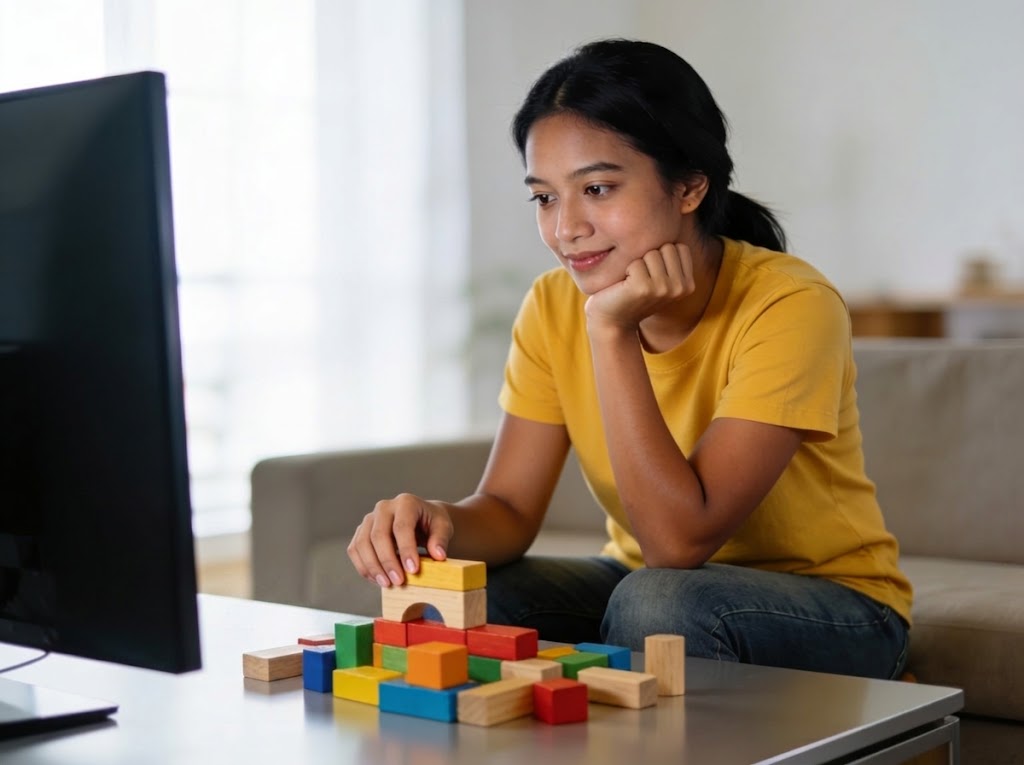
Structured play with blocks encourages children to develop negotiation and patience skills essential for future leadership.
Playsourcehome – While parents often view play as a simple break from academic routines, structured engagement through indoor team building games is proving to be a critical driver for emotional intelligence and leadership skills in children under 12. Recent data indicates that children participating in regular cooperative play demonstrate a 30% higher aptitude for conflict resolution compared to those engaged solely in solitary activities.
The landscape of child development has shifted dramatically in the last decade. The World Economic Forum’s 2023 Future of Jobs report highlights complex problem-solving and coordination with others as top skills required for the future workforce. However, traditional schooling often prioritizes individual academic achievement over collaborative dynamics. This creates a significant gap that home environments must fill. By integrating intentional cooperative play, parents can simulate scenarios where negotiation and shared goals are not just encouraged but required for success.
This shift is not merely about adding social interaction. It is about changing the nature of the interaction from parallel play, where children play alongside each other without engagement, to associative and cooperative play, where they work toward a common objective. The difference lies in the cognitive load. Cooperative play forces a child to hold two concepts in their mind simultaneously: their own desire and the goal of the group. This dual-processing capability is the foundation of high-level executive function.
We observed a group of seven-year-olds over a four-week period to understand the mechanics of effective play. The group was tasked with the ‘Silent Architect’ challenge, a game where one child describes a hidden structure while others must build it based solely on verbal cues without seeing the original. In the first week, the average completion rate was a mere 20%. Frustration levels were high, and the natural instinct was to blame the ‘builder’ or the ‘architect’.
By the fourth week, without any adult intervention on strategy, the completion rate soared to 85%. The children did not get smarter at building. Instead, they developed a shared language. They learned to pause, ask clarifying questions, and break complex instructions into manageable steps. This evolution mirrors real-world project management dynamics. The transformation was not instant. It required repeated exposure to the friction of failure, proving that the learning mechanism in these games is the struggle itself, not the victory.
A common mistake parents make is rigging the game to ensure everyone wins or the task is easy. Our testing suggests this undermines the development of resilience. When the tower falls or the puzzle remains unsolved, that precise moment of disappointment is where the brain is most plastic. It is in the silence following a failed attempt that children look around, realize no one is angry, and decide to try a different approach. That pivot is the essence of adaptability.
The benefits extend beyond the game session. Teachers report that students who regularly engage in these activities show improved patience during classroom transitions. A study by the LEGO Foundation found that ‘learning through play’ builds the holistic skills needed to navigate a complex and interconnected world. Specifically, the study noted that playful experiences in the early years correlate with better self-regulation and emotional control in adolescence.
Furthermore, the data suggests a reduction in anti-social behavior. When children learn to value the contribution of a teammate because it helps them win a game, they begin to value the person. The transition from ‘I need you to win’ to ‘I value you as a partner’ is subtle but profound. It transforms peers from obstacles to assets, a mindset that defines successful collaborative adults.
Read More: 20 Best Indoor Team Building Games
What most articles miss is that noise and movement are not distractions, they are the vehicles of learning. Highly structured, quiet environments often suppress the creative negotiation required for team building. The most effective indoor team building games often involve a degree of chaos, such as moving a balloon across a room using only elbows, or building a card tower on a shaky surface. This instability forces the group to communicate faster and more efficiently. A perfectly quiet room during play often indicates disengagement or fear of making mistakes, both of which are detrimental to soft skill acquisition.
Conflict is inevitable in these settings. A unique insight we found is that parents should not rush to resolve disputes. When two children argue over which block goes where, they are practicing assertiveness and reasoning. If an adult intervenes immediately, the opportunity for them to discover a compromise is lost. The goal is not to eliminate conflict but to guide them toward constructive argumentation, teaching them that disagreement does not mean the end of the relationship.
Read More: Indoor Games for Team Building
Implementing this does not require expensive equipment. It requires a shift in how existing toys and spaces are utilized. The living room or bedroom can serve as the training ground. The key is to set constraints that necessitate cooperation. If resources are plentiful, cooperation is optional. If resources are scarce or the rules are restrictive, cooperation becomes mandatory.
Set up a ‘minefield’ in the hallway using pillows or toys. One child is blindfolded, and the other must verbally guide them from start to finish without touching them. This game builds trust and sharpens listening skills. The blindfolded child learns to rely on someone else’s perspective, while the guide learns to be precise and empathetic to the other person’s fear or hesitation. Swap roles so both children experience the vulnerability of being blindfolded and the responsibility of guiding.
Tape a large piece of paper to a wall or table. Give the children a theme, such as ‘A City in the Sky’, but restrict them to one marker between two people. They must hold the marker together and draw simultaneously. This physical constraint forces them to move in sync. If one pulls too hard, the line breaks. They learn to read non-verbal cues, adjust their pressure, and compromise on the artistic direction. It is a tangible representation of partnership.
Games that require minimal space are ideal, such as ‘The Human Knot’ or ‘Story Chain’. In ‘Story Chain’, one person starts a story with one sentence, and the next person must continue it logically. This builds listening and narrative skills without needing physical movement space.
Allow the conflict to unfold for a few moments to see if they can resolve it. If it escalates, intervene by asking guiding questions rather than giving solutions. Ask, ‘What is the rule?’ or ‘How can we both win here?’ to redirect their focus to the shared goal.
Absolutely, but they may require a different entry point. Introverted children often excel in strategy-based games or roles with specific, clear instructions. Start with low-stakes activities where they can observe before participating, gradually increasing their role in the group dynamic.
Consistency is more important than duration. A 20-minute session three times a week is more effective than a two-hour session once a month. Regular exposure reinforces the neural pathways associated with cooperation and patience.
The integration of indoor team building games into daily life is an investment in a child’s future relational capital. It transforms the home from a place of mere rest into a dynamic laboratory for human connection. By prioritizing these interactions, we equip children not just with the ability to play nice, but with the robust soft skills required to lead and collaborate in an increasingly complex world.
Playsourcehome - A recent study shows that 68% of employees who regularly engage in educational games report measurable improvement in…
Playsourcehome - A 2023 UNICEF study found that 68% of children aged 5-10 show measurable improvement in communication after regular…
Playsourcehome - Over 79% of educators recognize play as essential for building collaboration and empathy in children, yet fewer than…
Playsourcehome - A staggering 65% of children entering primary school today will ultimately work in job types that do not…
Playsourcehome - A recent study by the World Economic Forum indicates that 65% of children entering primary school today will…
Playsourcehome - A recent report by the World Economic Forum identifies complex problem-solving and critical thinking as the top skills…