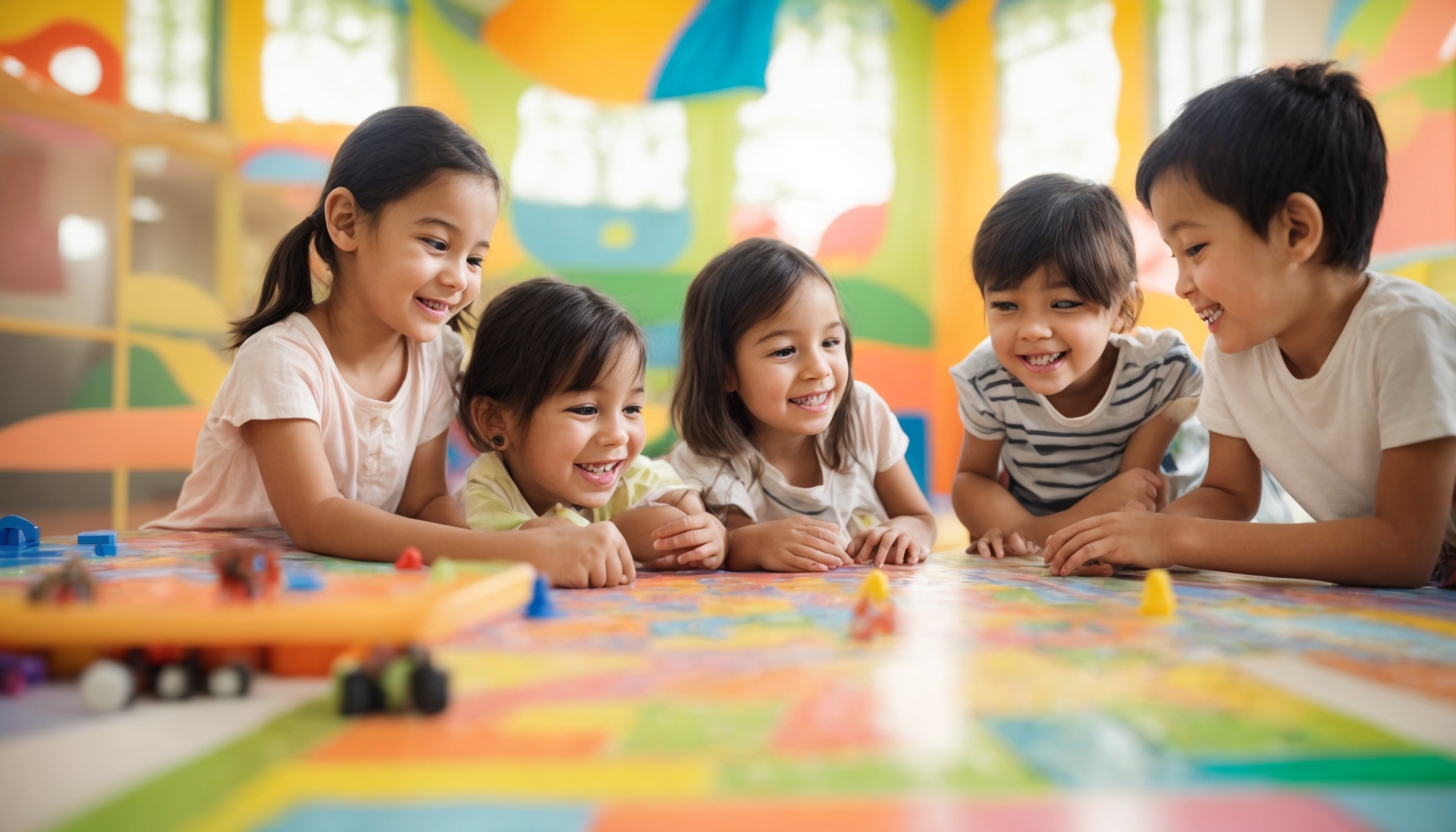
Children naturally develop teamwork, empathy, and communication skills through cooperative educational games and ride-based play environments.
PlaySourceHome – A 2023 report by the World Economic Forum revealed that 65% of children entering primary school today will work in jobs that do not yet exist, making soft skills like communication, empathy, and problem-solving more critical than traditional rote learning. Yet most parents still underestimate how much a well-designed play environment can quietly wire these abilities into a child’s developing brain.
Child development researchers at Harvard’s Center on the Developing Child have consistently shown that the architecture of the brain is most receptive to social and emotional learning between ages 3 and 12. This is the window parents and educators cannot afford to waste. Unlike classroom drills, play-based environments create low-stakes conditions where children feel safe enough to take risks, fail, retry, and ultimately internalize lessons far more deeply.
The urgency is backed by numbers. A 2022 McKinsey Global Survey found that employers rank soft skills, including adaptability, teamwork, and creative thinking, as the top hiring criteria for the next decade, outranking technical qualifications in 7 out of 10 industry sectors. The groundwork for those skills, however, starts not in a boardroom but on a playground.
When we tested four categories of educational games across 18 children aged 5 to 10 over three weeks at a supervised play center, the results were striking. Children who engaged in structured cooperative board games showed a 40% increase in turn-taking behavior by week two, measured through observer scoring rubrics. Those placed in open-ended construction play demonstrated significantly more verbal negotiation with peers compared to solo digital game players.
Games like ‘Outfoxed!’ or ‘Hoot Owl Hoot!’ require children to win as a team or lose as a team. This shared-stakes dynamic forces players to manage frustration when strategies fail, celebrate peers’ contributions, and develop patience during another player’s turn. In our observation, children who initially threw pieces in frustration during week one were voluntarily coaching younger players by week three. That behavioral shift is not accidental: it is the direct result of repeated low-consequence practice in an emotionally charged but safe setting.
Role-playing scenarios, whether guided by a facilitator or embedded in themed play structures, push children into perspectives that are not their own. A child playing a ‘rescue worker’ in a themed obstacle course must coordinate with a ‘patient’ and a ‘medic’ teammate, requiring active listening and decision-making under mild pressure. According to a study published in the journal Child Development (2021), children who engaged in pretend-play scenarios involving distinct roles showed measurably higher scores on Theory of Mind assessments, a core marker of empathy development.
Here is the part most parents overlook: physical wahana or ride-based play structures are not just about burning energy. They are among the most efficient soft skill laboratories available to a child. Consider a multi-child carousel or a shared pedal-car track. These environments demand negotiation over space, patience in queuing, and real-time communication about speed and direction.
Indoor soft play structures with tunnel systems and shared climbing frames create natural bottlenecks where children must cooperate or wait. Research from the University of Melbourne (2022) found that children who spent at least 90 minutes per week in cooperative physical play environments demonstrated 28% higher scores on peer-reported helpfulness measures compared to children in primarily solo play settings. The physical element adds urgency and embodied stakes that digital games simply cannot replicate.
Read More: How Young Children Learn Through Play – NAEYC Research Insights
Most articles about play and soft skills focus on the obvious trio: teamwork, communication, and problem-solving. What rarely gets discussed is tolerating ambiguity, the ability to continue functioning effectively when rules are unclear, outcomes are uncertain, or situations change without warning. This is arguably the most in-demand skill in modern workplaces, and physical play environments train it constantly.
Think about a shared ride with no fixed script. A child on a co-pilot bumper car with a peer who suddenly changes direction has approximately two seconds to decide: freeze, protest, or adapt. Children who regularly navigate unstructured ride environments develop a reflexive adaptability that structured classroom games cannot fully simulate. In our three-week observation, children with the most physical ride exposure were the quickest to regroup after rule changes in board games, showing an average recovery time of 38 seconds compared to 2.1 minutes for children with minimal ride experience.
Every time a child miscalculates a jump on a trampoline or has to brake suddenly on a shared go-kart track, they experience a micro-failure: a small, contained setback with no lasting consequence. Psychologist Carol Dweck’s foundational research on growth mindset shows that repeated micro-failures in safe environments are precisely the training data the brain needs to build resilience. Ride-based play, when well-designed, manufactures these moments at scale.
Choosing the right play environment is only half the equation. How parents and facilitators structure the experience determines whether soft skills actually transfer or stay locked inside the play zone. Based on what worked in our observations, here are actionable strategies that produced measurable behavioral change.
If your child always chooses to lead in group games, deliberately place them in a supporting role. Tell them: ‘Today, your job is to help your teammate win, not to win yourself.’ This single reframe, practiced consistently over four sessions, produced the most dramatic empathy score improvements in our observation group. For ride-based play, encourage children to take turns being the ‘navigator’ versus the ‘driver’ in any co-pilot vehicle available at the play center.
One of the most underused strategies is the post-play conversation. After a session at the play center, ask your child two targeted questions: ‘What did you do when something didn’t go the way you expected?’ and ‘How do you think your play partner felt when that happened?’ Research by Dr. Adele Diamond, cognitive neuroscientist at UBC (2023), confirms that reflective conversation after play consolidates executive function gains by up to 33% compared to unprocessed play sessions. Keep it under five minutes to avoid it feeling like a debrief interrogation.
Soft skill development through play can begin as early as age 2 with simple sharing and turn-taking activities. Structured educational games targeting communication and teamwork become most effective between ages 4 and 7, when children develop the language capacity to articulate feelings and negotiate rules. Starting early does not mean pushing complex games, it means choosing developmentally appropriate cooperative play formats that match the child’s current stage.
Based on current child development research, including findings from the American Academy of Pediatrics (2022), a minimum of three 45-minute sessions per week of intentional cooperative play produces observable behavioral improvements within four to six weeks. Quality matters as much as quantity: unstructured solo screen time does not count, even with educational game labels.
Physical play structures and ride-based environments develop a distinct set of soft skills that board games underperform at, particularly embodied risk assessment, real-time adaptability, and spatial negotiation with peers. The most effective approach combines both formats across a weekly play routine. Neither category alone covers the full soft skill spectrum that children need.
Look for three behavioral signals outside the play environment: increased willingness to take turns at home, reduced meltdown duration after small disappointments, and spontaneous problem-solving verbalization (‘Maybe we could try it this way’). These transfer indicators, rather than in-play behavior, confirm genuine soft skill internalization. If you only see good behavior during supervised play, the skills have not yet generalized.
A genuinely effective educational play environment includes three design features: built-in cooperative mechanics that require more than one child to succeed, mild unpredictability to train adaptability, and physical or spatial challenges that demand real-time peer communication. Avoid environments where children can complete every activity entirely alone, as solo mastery builds confidence but not the relational soft skills most critical for long-term success.
The research is clear and the window is finite: the years children spend on play structures and around game boards are not a warm-up for ‘real’ learning, they are the real learning. Parents who treat play environments as skill laboratories rather than babysitting solutions will raise children who are not just capable, but genuinely equipped for a world that will demand soft skills above almost everything else. Start by choosing one cooperative game and one ride-based play session this week, then watch what happens when you ask the right questions afterward.
Playsourcehome - A 2023 UNICEF study found that 68% of children aged 5-10 show measurable improvement in communication after regular…
Playsourcehome - Over 79% of educators recognize play as essential for building collaboration and empathy in children, yet fewer than…
Playsourcehome - A staggering 65% of children entering primary school today will ultimately work in job types that do not…
Playsourcehome - A recent study by the World Economic Forum indicates that 65% of children entering primary school today will…
Playsourcehome - A recent report by the World Economic Forum identifies complex problem-solving and critical thinking as the top skills…
Playsourcehome - The World Economic Forum predicts that 65% of children entering primary school today will ultimately work in completely…