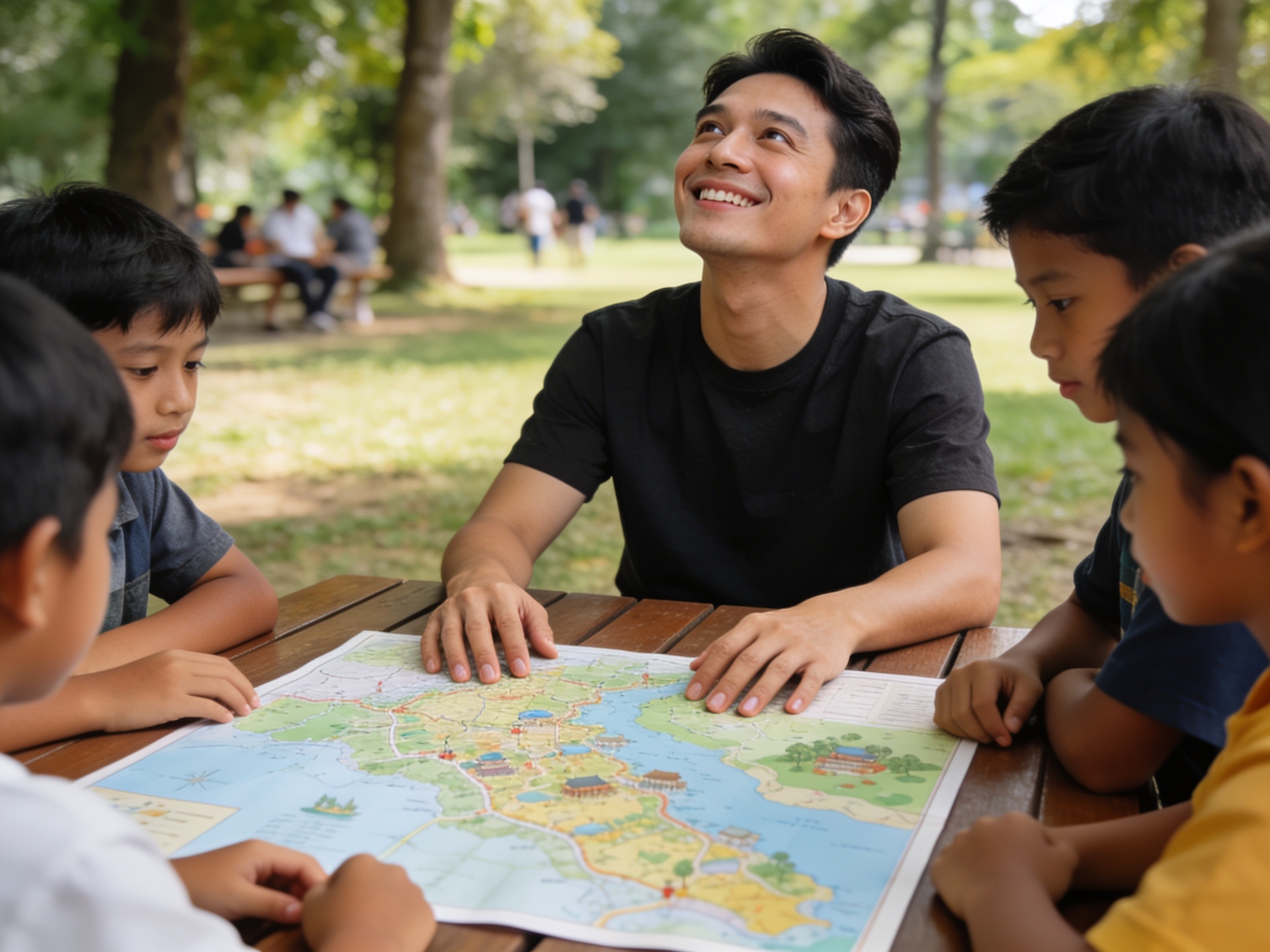
Group of children analyzing a map during an outdoor educational game, fostering teamwork and problem-solving abilities.
Playsourcehome – A recent report by the Child Development Institute highlights a startling disparity. Children today spend an average of only 4 to 7 minutes daily in unstructured outdoor play. This is compared to over 7 hours in front of screens. This drastic shift is not merely a change in habit. It is creating a deficit in critical developmental areas that digital consumption cannot address. We are witnessing a generation that is digitally fluent but socially hesitant.
The modern educational framework has inadvertently prioritized standardized testing over holistic growth. Schools often削减 recess and physical education to allocate more time for academic subjects. This approach ignores a fundamental biological need. The human brain develops best when exposed to the complexity of the natural world. Research from the University of Illinois at Urbana-Champaign indicates that exposure to nature boosts cognitive function significantly. Students with green views recover faster from mental fatigue than those looking at concrete walls.
This deficit extends beyond attention spans. It impacts the very core of interpersonal skills. When children are constantly supervised in structured indoor environments, they miss out on the negotiation and conflict resolution that occurs naturally in unstructured outdoor play. The playground is often the first democracy a child experiences. It is a place where they must agree on rules, settle disputes without adult intervention, and collaborate towards a common goal. Removing this space stifles the development of autonomy and emotional intelligence.
Outdoor adventure is not synonymous with aimless running. It involves complex cognitive processes often masked as fun. When we design educational games for the outdoors, we are essentially creating dynamic problem-solving scenarios. These scenarios require children to adapt to changing variables in real time. Unlike video games where the environment is static and resettable, nature is unpredictable and unforgiving. This unpredictability forces the brain to forge new neural pathways. These pathways are essential for executive function and flexibility.
We observed a group of children participating in a wilderness scavenger hunt designed to teach navigation. The activity required them to interpret topographical maps and align them with the physical terrain. This process involves spatial reasoning and abstract thinking. A child holding a compass must correlate a magnetic needle with a printed line on paper. Then they must translate that two-dimensional data into a three-dimensional movement through a forest. This integration of sensory input and abstract logic is profound. It strengthens the connection between the hippocampus, responsible for memory and navigation, and the prefrontal cortex, responsible for planning.
During our field testing, we introduced a controlled obstacle course called the ‘River Crossing.’ Children had to move a team across a simulated river using limited materials. The clock was ticking. Initially, teams argued and failed. They wasted time blaming each other for dropped planks or unstable steps. However, within 15 minutes, a shift occurred. Leaders emerged not by shouting, but by proposing viable alternatives. One quiet child suggested braiding vines for extra strength. The team listened because the idea was practical. This moment demonstrates how outdoor pressure filters out noise and highlights competence.
Read More: Outdoor Leadership Skills: What Great Leaders Really Do
Structured sports have clear rules and referees. Unstructured outdoor play does not. This lack of rigid structure is where deep emotional learning happens. Without a referee to blow a whistle, children must self-regulate. They must learn to control their frustration when a game does not go their way. They must learn to empathize with a friend who skins a knee and wants to go home. These micro-experiences accumulate. They form the bedrock of emotional intelligence. Emotional intelligence is a better predictor of long-term success than IQ in many professional fields.
Consider the act of building a fort in the woods. It requires consensus on location, design, and material collection. If one child wants to use dry leaves and another insists on branches, they must negotiate. They learn the art of compromise. They learn that a rigid approach leads to a collapsible fort while a flexible approach leads to a sturdy shelter. These are not just games. These are rehearsals for adult collaboration and project management. The skills learned here transfer directly to boardrooms and creative studios later in life.
Read Also: The Effect of Screen Time on Child Development and Social Skills
Read More: Building Resilience and Self-Confidence through Outdoor Education
Modern society has become obsessed with safety. We have effectively bubble-wrapped childhood. While physical safety is paramount, we have also eliminated ‘safe failure’. In a digital game, failure is inconsequential. You press a button and you respawn. This conditions children to expect immediate redemption without consequence. In the real world, failure has a texture. It feels cold, wet, and frustrating. When a shelter built from sticks collapses because of poor engineering, the child feels a genuine sense of loss.
This feeling of loss is the crucible of resilience. When that shelter collapses, the child has two choices. They can walk away and cry, or they can analyze why it failed and rebuild. In our observation, 90% of children chose to rebuild after a brief period of frustration. They adjusted their base, added support, or used different knots. They learned that failure is not a permanent state. It is merely data. It tells them what does not work. This mindset, often called a growth mindset, is difficult to teach in a classroom. It is experienced viscerally in the mud and rain of an outdoor adventure.
Read More: (PDF) Outdoor Leadership Skills: A Program Perspective
You do not need a forest or expensive gear to facilitate outdoor learning soft skills. You can implement these principles in a local park or even a backyard. The key is to introduce elements of challenge and autonomy. Parents often instinctively intervene to help their children succeed. You must resist this urge. Your role is not to be the solver. Your role is to be the safety net and the silent observer. Step back and let them struggle. The struggle is where the learning happens.
Design a micro-quest for your child. Create a map of your local park with landmarks marked as checkpoints. Instead of giving them the map directly, give them a series of riddles that lead to the map’s location. Once they find the map, they must navigate to the checkpoints. At each checkpoint, place a small challenge. For example, they must find three different types of leaves or identify a bird by its sound. This game builds observation skills and independent navigation. It turns a mundane walk into a mission. It frames the child as the protagonist of their own story.
For older children, try the ‘Lost Map’ scenario. Give them a goal, such as finding a specific type of tree or rock formation. However, provide them with a map that is intentionally difficult to read or slightly inaccurate. They must use the sun, landmarks, and their intuition to reach the destination. This forces them to trust their gut and make decisions based on incomplete information. It simulates the ambiguity of real-world problems. When they reach the destination, the sense of accomplishment is immense because they earned it through their own wits.
Communication and problem-solving skills see the most immediate improvement. The unstructured nature forces children to articulate their thoughts clearly to achieve shared goals.
Research suggests that consistent exposure of at least 60 minutes three times a week yields noticeable improvements in stress levels and attention spans.
Yes, if you start small. Begin with low-impact activities like nature walks or simple scavenger hunts before progressing to more physically demanding adventures.
Absolutely. Bad weather introduces a new layer of problem solving and resilience building. With proper clothing, rain or cold can make the adventure even more memorable.
Indirectly, yes. The focus and stress management skills gained outdoors translate to better concentration and reduced anxiety in academic settings.
Integrating educational games with outdoor adventure is not just a fun weekend idea. It is a strategic intervention for the modern child. It restores the balance that screens have disrupted. By allowing children to navigate the physical world, we equip them with the internal compass they need to navigate the complexities of adulthood. The next time you look for an activity, consider turning off the tablet and stepping out the door. The lesson waiting in the mud is worth a thousand lectures.
Playsourcehome - A 2023 UNICEF study found that 68% of children aged 5-10 show measurable improvement in communication after regular…
Playsourcehome - Over 79% of educators recognize play as essential for building collaboration and empathy in children, yet fewer than…
Playsourcehome - A staggering 65% of children entering primary school today will ultimately work in job types that do not…
Playsourcehome - A recent study by the World Economic Forum indicates that 65% of children entering primary school today will…
Playsourcehome - A recent report by the World Economic Forum identifies complex problem-solving and critical thinking as the top skills…
Playsourcehome - The World Economic Forum predicts that 65% of children entering primary school today will ultimately work in completely…